Knowing your hair texture is key to a good hair care routine and healthy scalp. Hair classification systems have changed, making it easier to sort different types of hair texture.
The Andre Walker Hair Typing System is a well-known way to sort hair types, from straight to coily. Knowing your specific hair type and texture helps pick the right products and treatments. This leads to healthier hair.
Key Takeaways
Understanding hair type and texture is vital for proper hair care.
Hair classification systems have evolved to offer more accurate categorizations.
The Andre Walker Hair Typing System is a widely recognized classification method.
Knowing your hair type and texture helps in selecting appropriate hair care products.
Proper hair care routines can lead to improved scalp health.
The Science of Hair Texture Classification
Hair texture classification has changed a lot over time. At first, it was simple, but now it’s more complex and detailed.
Evolution of Hair Typing Systems
The Andre Walker Hair Typing System is well-known. It divides hair into four main types based on curl pattern. But, recent studies show hair texture is more than just curl pattern. It also includes strand diameter, density, and porosity.
Other systems, like L’Oreal’s eight-type classification, show how complex hair texture really is.
Why Understanding Your Hair Type Matters
Knowing your hair type is key for good hair care. Different hair types need different things. For example, curly hair is drier than straight hair because of its structure.
It needs more moisturizing products. By knowing your hair type, you can choose the right products and styling. This leads to healthier and easier-to-manage hair.
7 Primary Hair Texture Types Explained
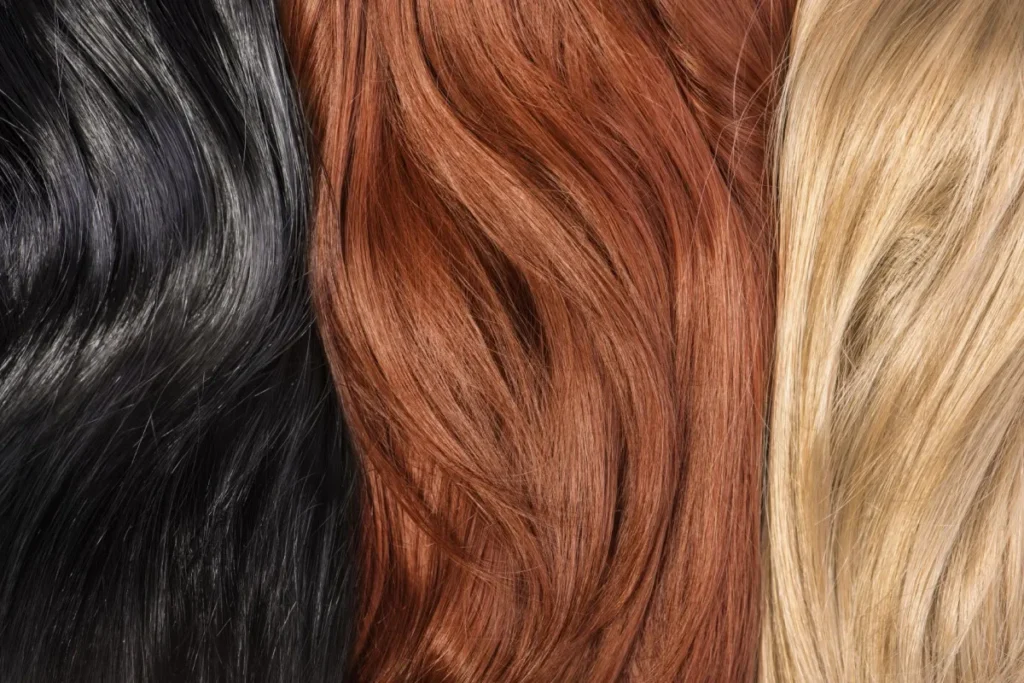
Hair textures vary from straight to coily, each with its own traits. Knowing these differences helps pick the right hair care. There are four main types: straight, wavy, curly, and coily, with subtypes A, B, C based on curl tightness.
Type 1: Straight Hair
Straight hair shines and lacks wave or curl. It’s oily because scalp oils easily slide down. Styling is easy, but it gets greasy if not cared for.
Care tips: Use a gentle, sulfate-free shampoo to keep it clean without losing natural oils. For volume, try a lightweight conditioner or volumizing spray.
Type 2: Wavy Hair
Wavy hair is between straight and curly, with a gentle “S” shape. It’s frizzy and dry, needing moisture, mainly at the ends. It’s versatile, styling easily from natural to straight.
Use a hydrating mask once a week to combat dryness.
Apply a sea salt spray to enhance the natural texture and wave.
Type 3: Curly Hair
Curly hair has distinct ringlets, varying in size and tightness. It’s drier than other types because curls block oils. Moisture-rich products are key to keeping it healthy and defined.
Quote:
Use a sulfate-free shampoo and deep conditioning to keep curly hair healthy and looking good.
Type 4: Coily/Kinky Hair
Coily or kinky hair has a tight “Z” shape and is the most fragile. It needs extra moisture and care to avoid breakage. Heavy, moisturizing products and protective styling are best.
Care tips: Use a gentle, moisturizing cleanser and a leave-in conditioner or hair butter to lock in moisture. Protective styles like braids can help reduce manipulation and prevent breakage.
Understanding and embracing your hair texture is the first step to healthy, beautiful hair. By identifying your hair type and using the right care techniques and products, you can enhance its natural beauty.
Conclusion
Knowing your hair type and texture is key to picking the right hair care products and routines. There are seven main hair texture types. Understanding your hair’s unique traits helps you make better hair care choices.
Identifying your hair type lets you choose products and methods that meet your hair’s needs. This can lead to healthier and easier-to-manage hair. It also boosts scalp health and improves how your hair looks.
Everyone’s hair type is different, but knowing the various textures helps you find the best hair care. Embracing your hair’s natural texture leads to a more effective hair care routine.
Understanding your hair type is the first step to better hair and scalp health. It sets you on the path to having healthier, more vibrant hair.
FAQ
What are the main hair texture types?
The main hair texture types are straight (Type 1), wavy (Type 2), curly (Type 3), and coily/kinky (Type 4), each with varying levels of bend, volume, and shrinkage.
How do I determine my hair type?
Examine your natural hair pattern when it’s clean and air-dried without products—observe whether it lies flat, forms loose waves, defined curls, or tight coils.
What’s the difference between hair type and hair texture?
Hair type refers to the curl pattern (straight to coily), while hair texture describes the strand thickness (fine, medium, or coarse) and density.
Why is understanding my hair type important for hair care?
Knowing your hair type helps you choose suitable products, washing frequency, styling methods, and treatments to maintain healthy hair.
What are the characteristics of curly hair?
Curly hair (Type 3) forms defined ringlets or spirals, tends to be more prone to dryness and frizz, and benefits from moisture-rich products.
How do I care for coily/kinky hair?
Coily hair needs deep hydration, gentle detangling, protective styling, regular conditioning, and minimal heat to maintain strength and moisture.
Can I have multiple hair textures on my head?
Yes, many people naturally have a mix of textures, such as wavy at the front and curlier at the back.
What’s the most common hair type?
Globally, straight hair is the most common, though hair type distribution varies by ethnicity and genetics.
How often should I wash my hair based on its type?
Straight hair may need washing every 1–3 days, wavy every 2–3 days, curly about once or twice a week, and coily hair typically once a week or less depending on scalp needs.
References
National Center for Biotechnology Information. Evidence-Based Medical Insight. Retrieved from https://pubmed.ncbi.nlm.nih.gov/24123183/