The catagen stage of hair is known as the brief transitional period that bridges the active growth phase and the resting phase of the hair cycle. This phase, lasting only a few weeks, determines how many follicles move into the next stage and ultimately influences overall hair density. For anyone experiencing thinning or considering a hair transplant, grasping the nuances of this stage is essential because it signals when follicles are preparing to rest and later re‑enter growth.
Hair loss concerns affect roughly 40 % of men and 30 % of women by age 35, making early awareness of each growth phase a practical tool for prevention and treatment. While the anagen (growth) phase captures most attention, the catagen phase quietly prepares the follicle for renewal, and disruptions here can accelerate shedding.
In this article we will explore what occurs during the catagen phase, the biological factors that influence it, its relationship to hair loss and modern restoration techniques, and how clinicians monitor this stage to tailor personalized treatment plans.
What Happens During the Catagen Phase?
During the catagen phase, the hair follicle undergoes a controlled regression. The hair bulb shrinks, the lower part of the follicle detaches from the dermal papilla, and the follicle shortens dramatically. This process typically lasts 2–3 weeks, after which the follicle enters the telogen (resting) phase.
Cellular Changes
Keratinocytes in the hair matrix cease rapid division, and apoptosis (programmed cell death) begins. The papilla, a cluster of blood vessels that supplies nutrients, remains intact but reduces its activity, signaling the follicle to pause growth. This temporary shutdown protects the follicle from damage and prepares it for the next anagen cycle.
Structural Transformations
- Hair shaft shortening – the visible portion of the hair retracts as the follicle contracts.
- Formation of a “club hair” – a fully keratinized, dead hair shaft that will eventually be shed.
- Reduced melanin production – the hair may appear lighter as pigment synthesis slows.
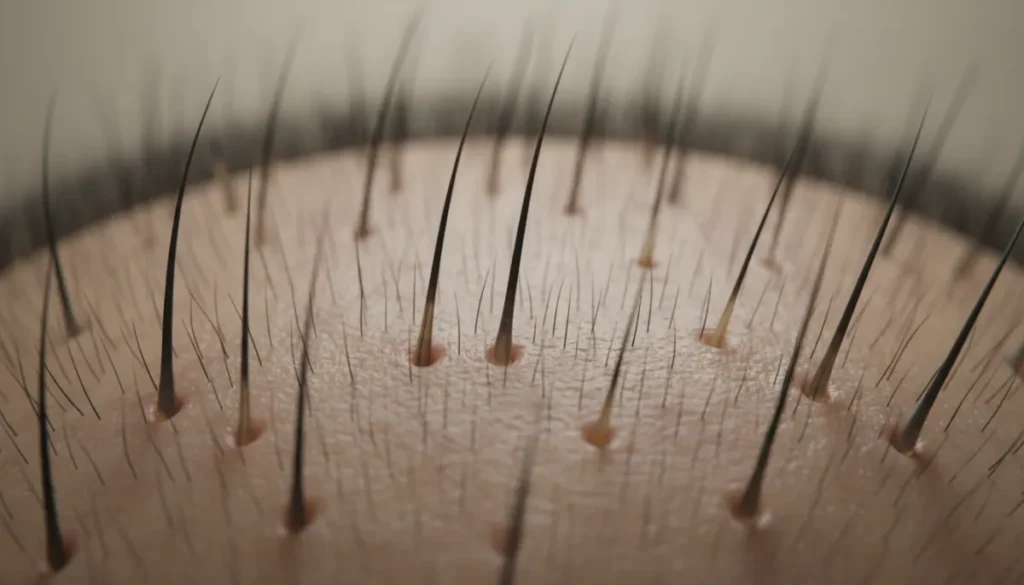
These changes are visible under a dermatoscope and can be mapped on a hair follicle diagram that highlights the shift from an active bulb to a dormant club hair.
Timeline Overview
| Phase | Duration | Key Events |
|---|---|---|
| Anagen | 2–7 years | Active growth, hair shaft elongation |
| Catagen | 2–3 weeks | Follicle regression, papilla detachment |
| Telogen | 2–4 months | Resting, eventual shedding |
Understanding this timeline helps clinicians predict when a patient’s hair will shed and when new growth may appear after a transplant or medication.
Key Factors That Influence the Catagen Stage
Several internal and external factors can accelerate or prolong the catagen phase, affecting overall hair health.
Hormonal Influences
Androgens, especially dihydrotestosterone (DHT), can shorten the anagen phase and push follicles prematurely into catagen. This is a primary mechanism behind androgenic alopecia, where the hair follicle miniaturizes over successive cycles.
Nutritional Status
Deficiencies in iron, zinc, and biotin can disrupt keratin production, leading to a prolonged catagen phase and increased shedding. A balanced diet supports the hair root and papilla’s metabolic needs.
Stress and Inflammation
- Physical or emotional stress triggers cortisol release, which can push follicles into catagen.
- Scalp inflammation, such as from seborrheic dermatitis, creates an unfavourable environment for follicle regeneration.
Medical Treatments
Chemotherapy drugs intentionally induce a rapid catagen transition, causing widespread hair loss. Conversely, medications like minoxidil extend anagen and may shorten catagen, promoting thicker growth.
Below is a quick reference list for clinicians to assess potential catagen accelerators:
- Hormonal imbalances (elevated DHT, thyroid disorders)
- Nutrient deficiencies (iron, vitamin D, zinc)
- Chronic stress or recent trauma
- Scalp conditions (psoriasis, eczema)
- Medication side‑effects (anticoagulants, retinoids)
How the Catagen Phase Relates to Hair Loss and Restoration
Understanding the catagen phase is crucial for both diagnosing hair loss patterns and planning effective restoration procedures.
Pattern Hair Loss
In androgenic alopecia, follicles repeatedly enter a shortened anagen phase followed by an accelerated catagen stage. Over time, the hair bulb becomes smaller, producing thinner “vellus” hairs. Recognizing this cycle helps surgeons decide the optimal timing for follicular unit extraction (FUE) or DHI transplants.
Transplant Timing
When a patient’s scalp is dominated by follicles in telogen, a surgeon may wait several weeks for them to re‑enter anagen before harvesting. This ensures that the extracted grafts contain robust hair roots and papillae, improving graft survival.
Post‑Transplant Care
After transplantation, the implanted follicles experience a temporary shock that forces them into catagen before re‑entering anagen. Patients often notice shedding of the transplanted hairs around 2–3 weeks post‑procedure—this is a normal “shock loss” and a sign that the follicles are resetting.
Adjunct Therapies
Low‑level laser therapy (LLLT) and platelet‑rich plasma (PRP) aim to prolong anagen and gently shorten catagen, encouraging quicker return to growth. Clinical studies show that combining PRP with FUE can increase graft retention by up to 15 %.
Below is a simplified comparison of common restoration approaches and their impact on the catagen stage:
| Approach | Effect on Catagen | Typical Outcome |
|---|---|---|
| FUE | Induces brief catagen shock, then rapid anagen | High graft survival, natural density |
| DHI | Minimizes handling, reduces catagen duration | Faster visible growth |
| PRP + FUE | Shortens catagen, supports papilla health | Enhanced graft retention |
| LLLT | Stimulates anagen, modest catagen reduction | Improved thickness over 6‑12 months |
Monitoring the Catagen Phase: Signs and Clinical Assessment
Detecting the catagen phase early allows clinicians to intervene before significant shedding occurs.
Visual Indicators
Patients may notice hair that feels softer at the root or a subtle increase in shedding during brushing. The “club hair” that forms during catagen is often longer than typical shed hairs, providing a clue for clinicians.
Dermatoscopic Examination
Using a dermatoscope, doctors can visualize the miniaturized bulb, reduced vascular supply, and the transition zone between the papilla and the shaft. This non‑invasive tool helps differentiate catagen from telogen or active anagen.
Biopsy and Histology
In complex cases, a scalp biopsy can reveal the proportion of follicles in each stage. Histological staining highlights the hair papilla and the degree of apoptosis within the matrix.
Non‑Invasive Imaging
- Trichoscopy – high‑resolution imaging of follicle morphology.
- Optical coherence tomography (OCT) – depth‑resolved view of follicle structure.
Clinicians often combine these methods with patient history to construct a comprehensive picture of the hair growth cycle.
Why Choose Gold City Hair for Your Hair Restoration Journey
Gold City Hair combines cutting‑edge science with personalized care. Since 2017, our clinic in Turkey has performed thousands of successful FUE, DHI, and eyebrow/beard transplants, focusing on the health of each hair follicle from the papilla to the shaft. Our transparent communication ensures you understand every stage of the hair growth cycle, including the crucial catagen phase, so you can make informed decisions about treatment timing and after‑care.
Ready to take the next step toward fuller, healthier hair? Contact Gold City Hair today to schedule a personalized consultation and learn how our expertise can guide your follicles through every growth phase.
FAQ
What is the catagen stage of hair growth?
The catagen stage is a brief transitional phase lasting 2–3 weeks where the hair follicle regresses before entering the resting telogen phase.
How do hormones affect the catagen phase?
Androgens, especially DHT, can shorten anagen and push follicles prematurely into catagen, accelerating hair loss.
Can nutrition influence the catagen stage?
Yes, deficiencies in iron, zinc, biotin, and vitamin D can prolong catagen and increase shedding.
Why does hair shed after a transplant?
Transplanted follicles experience a temporary shock that forces them into catagen before re‑entering anagen, causing shedding around 2–3 weeks post‑procedure.
What clinical tools are used to monitor the catagen phase?
Dermatoscopy, trichoscopy, optical coherence tomography (OCT), and scalp biopsies can identify catagen follicles.
How do adjunct therapies like PRP and LLLT affect catagen?
PRP and low‑level laser therapy aim to shorten catagen and prolong anagen, improving graft survival and hair thickness.