Knowing your hair texture is key to picking the right hair care. Millions dye their hair to look better, but many don’t know dye can harm their hair. Just one coloring can damage your hair’s structure.
Explore types of hair with this incredible amazing guide. Discover powerful secrets for incredible styling and achieve amazing hair results.
Studies show permanent dyes damage hair by breaking down proteins and stripping lipids. This leads to dry, broken hair. Knowing your hair type helps avoid this damage and keeps your hair healthy.
Key Takeaways
Understanding your hair texture is key for good hair care.
Permanent hair dyes can seriously harm your hair.
Knowing your hair type helps pick the right products and treatments.
Hair type charts help find your specific hair texture.
Good hair care can lessen damage from coloring.
Understanding Hair Textures and Their Characteristics

Knowing the science behind hair texture is key to finding out your hair type. It helps you choose the right hair care. Hair texture comes from the hair follicle’s structure, which shapes its curl and look.
The Science Behind Hair Structure
Experts at Allure say the hair follicle’s shape affects hair curl. A round follicle makes straight hair. Oval or elliptical follicles lead to wavy or curly hair. This is why knowing your follicle shape is important.
Cécred points out other key factors in hair texture: porosity, density, and strand width. Porosity is how well hair takes in moisture. Density is how much hair you have. Strand width is how thick each hair is. These all affect what your hair needs and how it reacts to products.
Why Identifying Your Hair Type Matters
Finding out your hair type is vital for picking the right hair care products. Knowing if your hair is straight, wavy, curly, or coily helps you choose the right products. This improves your hair’s health and look.
Also, knowing your hair’s specific needs based on its texture and other traits leads to better hair care. This means using the right shampoos, conditioners, and styling products. It helps your hair stay healthy and easy to manage.
The 7 Types of Hair and How to Identify Yours
Knowing your hair type can change your hair care game. There are many hair types and textures. It’s key to pick the right products and treatments for yours.
Experts like OLAPLEX Inc. and Cécred say knowing your hair type is essential. It helps you care for your hair effectively.
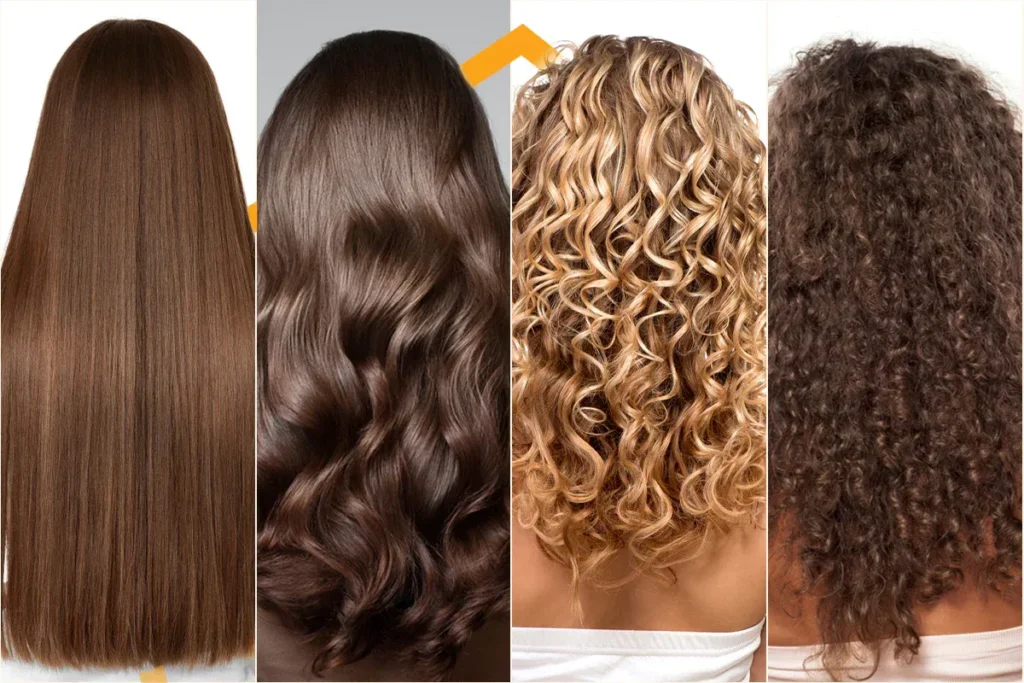
Type 1: Straight Hair
Straight hair lies flat and has no curl or wave. It often gets oily because scalp oils easily slide down. Use a gentle, sulfate-free shampoo and a light conditioner for straight hair.
Type 2: Wavy Hair
Wavy hair has a soft “S” shape. It can get frizzy or dry, mainly at the ends. Use a curl-enhancing product or sea salt spray to boost your natural look.
For more defined waves, try using a diffuser when blow-drying.
Type 3: Curly Hair
Curly hair has a clear “S” shape, from loose curls to tight spirals. It tends to be drier than other types. So, use moisturizing products and avoid heat styling.
Detangle curly hair gently in the shower. Use a wide-tooth comb or your fingers.
Type 4: Coily/Kinky Hair
Coily or kinky hair has a zig-zag pattern and is fragile. It needs gentle care, like regular deep conditioning and minimal handling. Use a sulfate-free shampoo and hydrating conditioner to keep it moisturized.
Understanding your hair type is the first step to healthy, beautiful hair. By identifying your hair type and using the right products and techniques, you can enhance your natural texture and keep your hair looking its best.
Conclusion: Embracing and Caring for Your Natural Hair Texture
Knowing your hair type is key to picking the right hair care. OLAPLEX Inc. says finding your hair type helps build a care plan. This plan supports hydration, strength, and protection.
Cécred’s hair care philosophy stresses the importance of loving your natural hair texture. By figuring out your hair type, you can start your hair care journey. You’ll find the right products for your hair typea.
To care for your natural hair texture, create a personalized hair care plan. Choose products that meet your hair’s specific needs. Whether it’s hydration, strength, or protection, take the Cécred Hair Quiz to find out your hair type. Start your journey to healthier, more vibrant hair.
Embracing your natural hair texture is more than just looks. It’s about keeping your hair healthy and strong. By understanding and caring for your hair texture, you can unlock its full beauty. Enjoy a more confident, beautiful you.
FAQ
What are the main hair types?
The main hair types are straight (Type 1), wavy (Type 2), curly (Type 3), and coily/kinky (Type 4), with subcategories based on curl pattern and thickness.
How does hair coloring affect hair health?
Hair coloring can weaken the hair shaft, cause dryness, breakage, and split ends because chemicals like bleach or ammonia strip natural oils and proteins.
What determines my hair’s needs?
Hair needs are determined by texture, porosity, density, scalp condition, chemical treatments, and environmental exposure.
How do I identify my hair type?
Hair type can be identified by observing curl pattern, thickness, density, and how hair behaves when wet or dry.
What is the difference between hair texture and hair type?
Hair type refers to curl pattern and shape, while hair texture describes the thickness or diameter of individual strands (fine, medium, coarse).
How can I care for my hair type?
Care involves using suitable shampoos, conditioners, styling products, and protective methods tailored to your hair type and texture.
What is hair porosity, and why is it important?
Hair porosity refers to how well hair absorbs and retains moisture, which affects product choice, hydration, and styling methods.
Can I have multiple hair types or textures?
Yes, it’s common to have different textures or curl patterns across the scalp, requiring customized care for each section.
References
National Center for Biotechnology Information. Evidence-Based Medical Insight. Retrieved from https://pubmed.ncbi.nlm.nih.gov/36374002/