It’s important to know the different textures and curl patterns of black hair for proper care. The hair typing system divides hair textures into four main types. These are based on curl patterns and texture characteristics.
Knowing your hair texture helps you create a care routine that suits you. This article will look at the 12 black hair types. It will also give insights into various textures and curl patterns.
Key Takeaways
Understanding hair texture is key for good hair care.
The hair typing system groups hair into four main types.
Knowing your hair type is the first step to a care routine that’s just for you.
The 12 black hair types chart helps understand different textures and curl patterns.
Having a care routine that’s tailored to you can make your natural beauty shine.
Understanding Hair Typing Systems

The world of hair care is complex. Knowing your hair type is the first step to mastering it. Hair typing systems help you identify your hair’s unique characteristics. This makes it easier to choose the right products and styling techniques.
The Andre Walker Hair Classification Method
The Andre Walker Hair Classification Method is well-known. It categorizes hair into four main types based on curl patterns and texture. This method is great for understanding the diverse characteristics of Black hair.
Key Features of the Andre Walker Hair Classification:
Type 1: Straight hair
Type 2: Wavy hair
Type 3: Curly hair
Type 4: Kinky/Coily hair
Why Identifying Your Hair Type Matters
Identifying your hair type is key for the best hair care practices. By knowing your hair’s specific needs, you can:
Choose products that are suitable for your hair type
Select styling techniques that enhance your hair’s natural texture
Improve your hair’s overall health and appearance
Experts say, “Understanding your hair type is the foundation of a successful hair care routine.” By identifying your hair type and using the right techniques, you can unlock your hair’s full beauty.
Knowing your hair type empowers you to make informed decisions about your hair care. This leads to healthier, more manageable hair.
Black Hair Types Chart: Complete Breakdown
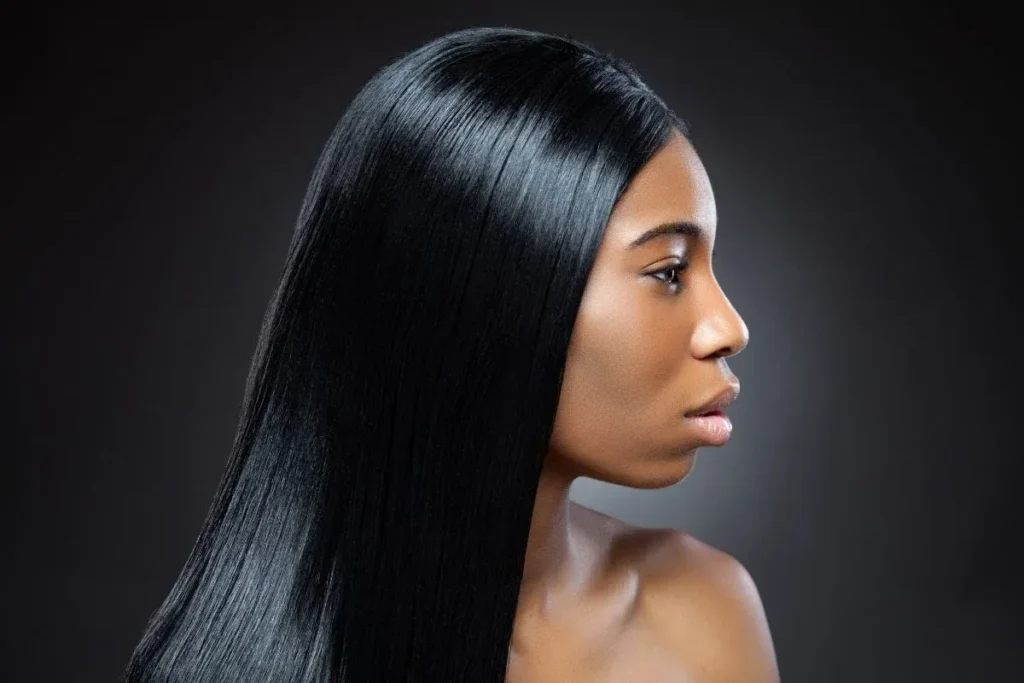
Black hair comes in four main types, each with its own look. Knowing these types helps you take better care of your hair.
Straight Hair Characteristics
Type 1 hair is straight, with no curl or wave. It often gets oily because the scalp’s oils slide down the hair shaft.
Lacks natural curl or wave
Tends to be oily
Can be fine or coarse in texture
Wavy Hair Patterns
Type 2 hair has a wavy texture, with a gentle “S” shape. It can be fine or coarse and often gets frizzy.
Has a gentle “S” shape
Can be fine or coarse
Prone to frizz, specially in humid places
Curly Hair Varieties
Type 3 hair is curly, with a clear “S” shape. It can be divided into subcategories based on how tight the curl is.
More defined “S” shape
Ranges from loose to tight curls
Can be dry if not moisturized well
Kinky Coily Hair Textures
Type 4 hair is kinky and coily, with a zig-zag pattern. It’s the most fragile and needs gentle care to avoid breakage.
Zig-zag pattern
Most fragile hair type
Needs gentle care and regular moisturizing
Understanding each black hair type helps you care for it better. You can pick the right products and styles to make your hair look its best.
Beyond Curl Patterns: Essential Classification Factors
To truly understand hair, we must look beyond curl patterns. Other essential characteristics are just as important. Curl patterns give valuable info, but they’re only part of a complete hair classification system.
Thickness Analysis
Hair strand thickness is key to understanding hair texture and manageability. It’s measured by the diameter of the strand. Finer strands have a smaller diameter, while thicker strands have a larger one.
Thickness Categories:
Fine: Less than 0.05mm in diameter
Medium: 0.05mm to 0.07mm in diameter
Coarse: More than 0.07mm in diameter
Knowing hair strand thickness helps choose the right hair care products and styling techniques.
Density Measurement
Hair density shows how closely packed the strands are on the scalp. It’s vital for determining hair’s appearance and manageability.
As noted by hair care expert,
Porosity Levels and Moisture Retention
Hair porosity shows how well hair absorbs and retains moisture. It depends on the cuticle layer’s ability to open and close, letting moisture in or out.
Porosity Levels:
Low Porosity: Cuticle layer is compact, making it hard for moisture to penetrate
Medium Porosity: Cuticle layer is moderately open, allowing for balanced moisture absorption
High Porosity: Cuticle layer is highly open, making it prone to excessive moisture absorption
Elasticity and Strength Indicators
Hair elasticity is its ability to stretch without breaking. Strength is its resistance to breakage. Both are key to hair health.
Elasticity Test: A simple way to check hair elasticity is by gently stretching a strand. If it snaps quickly, it may indicate low elasticity.
By understanding these essential factors, individuals can better understand their hair’s unique needs. This helps develop a more effective hair care routine.
Conclusion
Knowing the different black hair types is key for good hair care. A natural hair types chart helps find your hair texture and curl pattern. This makes it easier to pick the right hair care products and styling methods.
Looking at a hair chart for black hair helps you figure out your hair type. It teaches you how to take care of it. Whether you have a natural hair textures chart or a hair texture chart for natural hair, knowing your type is vital for healthy, beautiful hair.
Understanding black hair types leads to better hair care and styling. This knowledge helps achieve healthier, more beautiful hair.
FAQ
What is the Andre Walker Hair Classification Method?
The Andre Walker Hair Classification Method sorts black hair into four main types and their subtypes. It helps people understand their hair’s unique traits.
How many types of black hair are there?
There are four main types of black hair. These types have subtypes, leading to a wide variety of textures and curl patterns.
What are the different black hair textures?
Black hair textures include straight, wavy, curly, and kinky coily. Each type has its own characteristics and subtypes.
How do I identify my hair type?
To find your hair type, look at your hair’s curl pattern, texture, and other details. This includes strand thickness, density, porosity, and elasticity.
Why is it important to know my hair type?
Knowing your hair type is key for a good hair care routine. It helps you pick the right products and style your hair to show off its natural beauty.
What is hair porosity, and how does it affect my hair care?
Hair porosity is how well your hair takes in and holds moisture. Knowing your hair’s porosity is important for picking the right products and hair care routine.
How does hair elasticity impact my hair care?
Hair elasticity is how well your hair stretches and goes back to its original shape. Hair with good elasticity breaks less often. Knowing your hair’s elasticity helps you care for it better.
What is the difference between hair density and hair thickness?
Hair density is how many strands you have per square inch. Hair thickness is how thick each strand is. Knowing both helps you care for your hair better.
References
National Center for Biotechnology Information. Evidence-Based Medical Insight. Retrieved from https://pubmed.ncbi.nlm.nih.gov/37212612/